
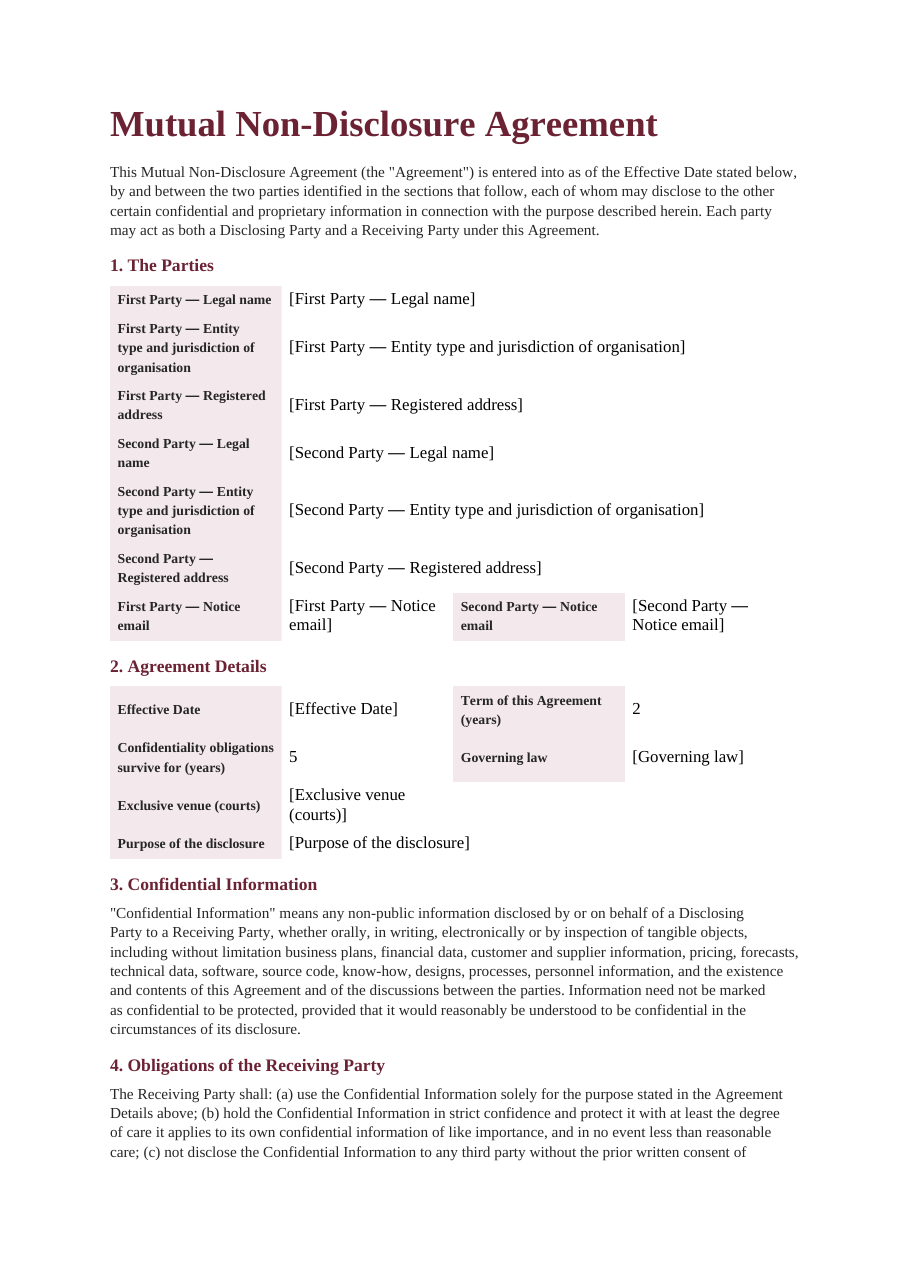
Mutual non-disclosure agreement template to fill in
Enter both parties' details, the purpose and the term, and get a mutual NDA ready to review and sign.
Free, no sign-up, no watermark.
Fill in the document
Every field is optional: fill in what you have and download the result.
What the document includes
Each of these is captured in the form and printed into the finished document.
- First Party — Legal name
- First Party — Entity type and jurisdiction of organisation
- First Party — Registered address
- Second Party — Legal name
- Second Party — Entity type and jurisdiction of organisation
- Second Party — Registered address
- First Party — Notice email
- Second Party — Notice email
- Effective Date
- Term of this Agreement (years)
- Confidentiality obligations survive for (years)
- Governing law
- Exclusive venue (courts)
- Purpose of the disclosure
- First Party — Signatory name
- First Party — Signatory title
- First Party — Date of signature
- Second Party — Signatory name
- Second Party — Signatory title
- Second Party — Date of signature
Frequently asked questions
What makes an NDA mutual?
Both sides may disclose and both are bound. A one-way NDA protects only the discloser, which is the wrong shape when two companies are exploring working together.
How long should the confidentiality term be?
Two to five years is typical for commercial information. Trade secrets are often kept confidential for as long as they remain secret.
Does an NDA need to be notarised?
No. It takes effect when both parties sign. Notarisation only helps evidentially, and is rarely used for NDAs.
Should a lawyer review it?
For a routine exploratory conversation this is a reasonable starting point. For anything involving source code, personal data or a large commercial relationship, have counsel review it before signing.